New CyberPest Management resources give farmers practical ways to protect their equipment, accounts, data and daily operations.
BATH, N.C. — A field day devoted to crop research, emerging technology and farm management added a new form of pest control this week: defending North Carolina farms from cyberattacks.
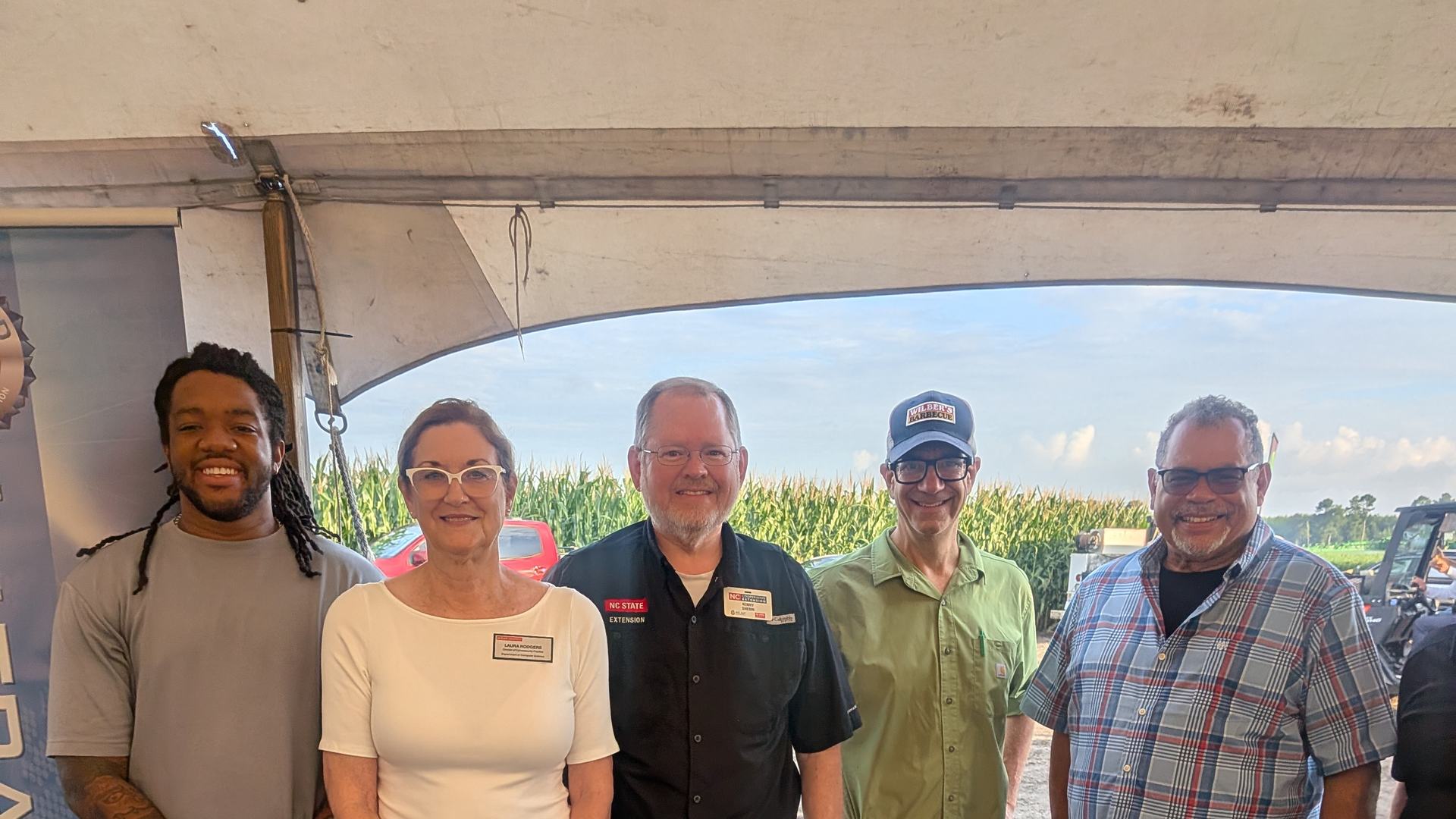
At the 56th annual Blackland Farm Managers Tour in Beaufort County on Aug. 5, NC State Extension and its AgDefenders Coalition partners launched a new Farm Cybersecurity website. The online hub offers farm-focused guidance for protecting connected equipment, financial accounts, business records and other digital systems that have become essential to modern agriculture.
The launch took place along Peoples Road between Bath and Burbage Crossroads, where Scattered Acres and Poole Farms hosted the annual tour. Farmers moved among research plots, demonstrations, exhibits and presentations highlighting technologies and management practices shaping agriculture.
The cybersecurity initiative delivered a timely warning: Every new digital tool can create another path into a farm operation if it is not properly secured.
For farmers, a cyber incident is not merely an information technology problem. It can interrupt irrigation, ventilation, feeding, refrigeration or access to equipment. It can lock up production records, expose sensitive information or redirect a legitimate payment to a criminal’s account. During planting, harvest or an animal-health emergency, even a short disruption can carry serious consequences.
The Food and Agriculture Sector is one of the nation’s 16 critical infrastructure sectors, reflecting the potential consequences a major disruption could have on the economy, public health and food supply. Federal officials have warned that ransomware and other cyberattacks can affect operations throughout the sector, from individual farms to major producers, processors and manufacturers.
Laura Rodgers, director of cybersecurity practice at NC State’s Secure Computing Institute, said protecting agriculture requires bringing cybersecurity expertise directly to the people responsible for producing the nation’s food.
“Food and agriculture is one of our nation’s critical infrastructure sectors, so protecting farms and the systems they rely on is essential to our food supply, economy and national security. Cybersecurity is a team sport. Everyone in the agricultural supply chain has a role to play – from farmers and agribusinesses using technology securely to equipment manufacturers and software companies designing security into their products from the start. Farmers should not be expected to carry this responsibility alone. NC State University’s Secure Computing Institute is honored to work alongside our fellow AgDefenders members to secure our food supply,” Rodgers said.
Cybersecurity as Farm Risk Management
The new Extension site approaches cybersecurity as another form of farm risk management. Its centerpiece, CyberPest Management, encourages producers to treat digital threats much as they would other production risks: Know what is present, prevent problems where possible, watch for warning signs, and have a plan to respond and recover.
The site begins with four core practices:
- Use a long, unique password for every important account.
- Turn on multifactor authentication, particularly for email, banking and farm-management systems.
- Learn to recognize phishing messages, payment scams and suspicious links.
- Keep computers, phones, applications and connected equipment updated.
These practices were selected because farmers can use them immediately without becoming cybersecurity specialists or investing in expensive new technology.
Amir Lawrence, a cybersecurity analyst with NC State’s Friday Institute for Educational Innovation, prepared much of the educational content for the site. His work focused on turning technical cybersecurity principles into clear, relevant guidance that farmers, family members and employees can put into practice.
“Cybersecurity can be a very intimidating subject for folks who aren’t as intimately familiar with technology. The best way that we can serve these populations is by meeting them where they are and building from there. When I was working on the materials, it was imperative that the information was both approachable and tangible. It had to relate to their lived experiences.
“We accomplished this by making sure we designed it with agriculture at the forefront. The core ideas are the same, but the work really depended on our ability to recognize farmers’ priorities and figure out how cybersecurity naturally fit within that world.
“My favorite aspect of the content was how we connected traditional farm experiences to their cybersecurity counterparts. For example, routine maintenance on a farmer’s equipment is the exact same idea as routinely checking for the latest updates to make sure your systems are secure.
“I hope our information isn’t just helpful for the farmers, but empowers them to make those kinds of connections on their own. Instilling that self-determination and demystifying those concepts is really the key to helping farmers make cybersecurity their own,” Lawrence said.
The resources extend beyond basic awareness. A tools and checklists section includes a connected-device inventory called “Count Your Herd, Count Your Hardware.” It encourages producers to identify the computers, phones, cameras, sensors, routers, controllers and online accounts used throughout their operations. It also contains a printable CyberPest Management Quick Guide for Farmers.
Other recommendations include backing up critical information, removing unused accounts, replacing default passwords, separating farm technology from home or guest Wi-Fi networks, and developing an incident-response plan before an emergency occurs.
Partnerships Built Around Critical Infrastructure
The launch brought together partners whose expertise spans agriculture, cybersecurity education, information sharing and law enforcement.
Daryl Thomas, president of the Eastern Carolina Chapter of InfraGard, represented the organization at the launch. InfraGard is a partnership between the FBI and members of the private sector that connects critical infrastructure owners, operators and stakeholders with the FBI for education, networking and information sharing related to security threats and risks.
“Cybersecurity awareness and education are at the core of what we do and how we work with the different critical infrastructure sectors. In this case, our goal is to help protect Farmers and their farming assets that are vital to our food and production sectors,” Thomas said.
Andrew Rose, an agricultural adviser to BIO-ISAC, brought a broader perspective on cyber and physical risks to agriculture and the bioeconomy.
“Cyber vulnerabilities in ag are like PFAS: Wherever you look, you find them. Fortunately, there are straightforward things a producer can do to make themselves a harder target. This is why the work that North Carolina is doing is critical to national security,” Rose said.
An FBI special agent also participated in the launch, reinforcing the importance of early reporting and communication with law enforcement when cyber-enabled crime occurs.
The site’s incident-response guidance puts physical safety and essential production first. Farmers are advised to assess risks to people, livestock, crops, food safety, water, ventilation, feeding, irrigation and refrigeration before focusing on the computer problem.
The guidance recommends safely isolating affected devices, preserving messages and other evidence, documenting what happened, and contacting qualified technical help, financial institutions, insurers and law enforcement as appropriate. It directs victims of cyber-enabled crime to the FBI’s Internet Crime Complaint Center and advises producers not to negotiate a ransom or make a payment on their own before contacting law enforcement, their insurer and qualified response professionals.
Protecting Farms Where the Work Happens
The partners are part of the broader AgDefenders Coalition, which brings together Extension, university researchers, cybersecurity professionals, government agencies and industry organizations to strengthen resilience across farms, agribusinesses and the food system.
Its emphasis is deliberately local. Small and midsized farms may assume they are unlikely targets, but cybercriminals frequently look for accessible accounts, unpatched equipment, reused passwords and people who can be pressured into opening a malicious attachment or approving a fraudulent payment.
Automated attacks do not need to know a farm’s acreage, revenue or number of employees before testing its digital defenses.
The launch at the Blackland Farm Managers Tour placed the message where it belongs: alongside the other tools, practices and relationships farmers use to manage risk.
AgDefenders partners share a commitment to ensuring that cybersecurity assistance reaches producers at the farm level — and that farmers are not left to confront unfamiliar digital threats alone.
“The AgDefenders Coalition is united by a shared passion for protecting the farmers and agricultural communities that sustain us. Launching our website at an event on a working farm was intentional; it reflects our commitment to listening to farmers, understanding the realities they face, and developing solutions grounded in their needs. Our long-term vision is to expand practical cybersecurity training, trusted resources and hands-on support so farms and agribusinesses of every size can become more resilient,” Rodgers said.
The message from Beaufort County was straightforward: Just as producers scout fields, maintain equipment and prepare for severe weather, they must protect the digital systems that keep their farms operating.
The new website gives them a practical place to begin.